Within one month, Sussex goes from summer to winter racing. The flat seasons at Goodwood and Brighton end, and the fences go up at Fontwell Park and Plumpton. Four courses, six fixtures, and between them nearly every kind of British racecourse: a ducal estate on the Downs, a horseshoe on a seaside ridge, a figure of eight in a village and a tight country jumps track with its own railway station.
The October 2026 calendar
- Saturday 3 October: Fontwell Park, jump racing
- Tuesday 6 October: Brighton, flat racing
- Sunday 11 October: Goodwood, flat racing, the season finale
- Thursday 15 October: Brighton, flat racing, the season finale
- Monday 19 October: Plumpton, jump racing
- Wednesday 21 October: Fontwell Park, jump racing
Fontwell Park's website also lists an extra afternoon fixture on Thursday 15 October, so check there before planning around it.
Goodwood: the Duke's garden party
Goodwood racing began as a favour. Until 1801 the officers of the Sussex Militia had held their annual races at Petworth Park, but that year the invitation was withdrawn. Charles Lennox, the third Duke of Richmond, stepped in and let them race on the Harroway, a narrow ridge on top of the Downs above his house. The private meeting went so well that a three-day public meeting followed in 1802. Its highlight was a match in which Rebel, owned by the Prince of Wales, beat the Duke's own horse, Cedar, for 100 guineas.
The summer meeting grew into Glorious Goodwood, and King Edward VII, who rarely missed it, famously called it "a garden party with racing tacked on". The racing is serious enough. Goodwood stages three Group 1 races: the Sussex Stakes, the Goodwood Cup and the Nassau Stakes. Frankel won the Sussex Stakes in 2011 and again in 2012. The course is still controlled by the Duke of Richmond's family.
For the form student, Goodwood is a course of extremes. The six-furlong straight, used for the Stewards' Cup, runs uphill and then down, and a tight right-handed loop at the far end feeds the longer races, with sharp turns and severe undulations. Horses need balance and a jockey needs a position. The 11 October finale is a gentler affair, with two-year-old races and handicaps and a relaxed autumn feel.
Brighton: the course that never comes back
Brighton's first public meetings on the present site date from 1783. The future George IV soon became its most glamorous patron, but the course itself is the real curiosity. It is a left-handed horseshoe about a mile and a half long, high on Whitehawk Hill, and it never completes a circuit. The final four furlongs drop steeply and then climb to the post, and the chalk beneath means the ground is rarely soft. It rewards nimble, well-balanced horses and punishes clumsy ones. The meeting on 15 October is Brighton's last of the year.
Fontwell Park: the figure of eight
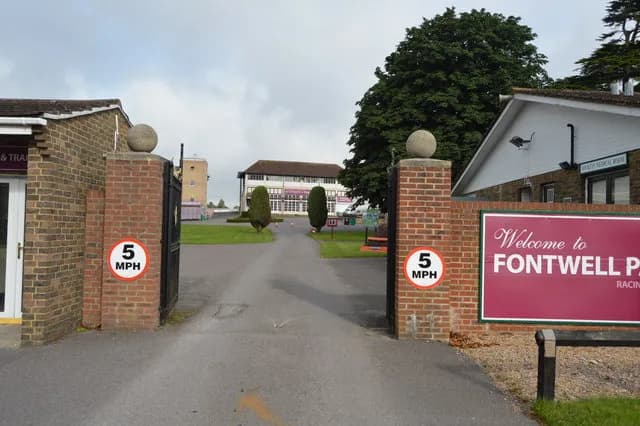
Fontwell Park was the creation of Alfred Day, who had trained racehorses in the village since 1887. The course opened on 21 May 1924, and the first race was won by Gem, the favourite. To make the most of a modest piece of land, Day's steeplechase course was laid out as a figure of eight, which survives today and is unique in Britain. The hurdles course is a conventional oval. Chasers therefore turn both ways, and spectators in the middle can see a lot of the action at close quarters.
Fontwell has royal history too. In October 1949 Princess Elizabeth, the future Queen, had her first winner as an owner here when Monaveen won the Chichester Handicap Chase. The course's top race today is the National Spirit Hurdle in February, a recognised trial for the Cheltenham Festival. A new grandstand opened in 2010, and the course is now owned by Arena Racing Company.
Plumpton: a small course with big moments
Racing at Plumpton, below the Downs north-west of Lewes, began in 1884, after hare coursing had been held on the land from 1876. Isidore Kerman bought it in 1961 and invested heavily, and the Southdown Stand opened in 1987. It is a tight, undulating, left-handed jumps course, and the hurdles and chases share the same uphill run to the winning post. That finish suits a handy horse that still has something left.
Plumpton has a habit of hosting milestones. Prince Charles rode in a charity race there in 1980 and finished second, and on 9 February 2009 AP McCoy rode his 3,000th winner at the course. The Monday 19 October card is billed as a charity raceday for the Bob Champion Cancer Trust.
For the seasoned racegoer
October in Sussex is a study in transition. On the flat, the closing cards at Goodwood and Brighton are about horses that have been on the go all summer, and about late-maturing two-year-olds. Form from firm summer ground can be misleading if autumn rain arrives, so the going report is worth reading carefully. Over jumps, the opposite applies: many runners at Fontwell and Plumpton will be having their first race for months, and some will need it. Course specialists matter at all four tracks, because each layout is so particular. A horse that has won round Brighton's horseshoe, Fontwell's figure of eight or Plumpton's tight turns has proved something that form elsewhere cannot.
For a first visit
If you are new to racing, Goodwood's finale and Brighton's last two cards offer flat racing with a relaxed, end-of-season feel, while Fontwell and Plumpton give a close-up view of jumping. Smart casual dress is fine at all of them, with layers and waterproofs for the jumps meetings. Visit the parade ring before each race and look for a horse that is calm, alert and walking well.
For betting, the Tote pools all stakes and shares them among winners; bookmakers lay a fixed price at the moment you bet. An each-way bet is two equal bets, one to win and one to place, so it costs twice the stake. Fix a budget before the first race and stick to it.
Making a day of it in Sussex
Each course pairs naturally with a place. Goodwood sits on the Downs above Chichester, where the cathedral, the Market Cross and the city walls make an easy afternoon, and Goodwood House is close by. Fontwell is a short drive from Arundel, with its castle and cathedral towering over the River Arun. Brighton's racecourse is a bus ride from the Royal Pavilion, the Lanes and the seafront. Plumpton's own station puts Lewes, with its castle and Anne of Cleves House, a stop or two away.
Getting there by rail is easy: Chichester station serves Goodwood, Barnham serves Fontwell, and Plumpton station adjoins its racecourse. By road, the A27 links all four.
Before you go
Check each course's website for times, tickets, the going and travel details. Autumn fixtures in Sussex can be hit by waterlogging or high winds, and any inspection or abandonment will be posted there first.