Discovery Beneath the Sussex Soil
Fishbourne Roman Palace lay hidden beneath two metres of soil for more than a thousand years until a chance discovery transformed our understanding of Roman Britain. Workers digging a trench for a water main in 1960 uncovered masonry foundations that archaeologist Barry Cunliffe and his team from the Sussex Archaeological Society would spend decades excavating.
The site had been briefly uncovered once before. In 1805, construction workers building a new home on the grounds discovered a 13-foot-wide Roman pavement and fragments of columns. Local residents found additional pottery and mosaic fragments in subsequent years, though none could conceive that these remnants were part of a far larger structure buried beneath their feet.
From Granary to Palace: A Timeline of Transformation
The site's history reflects the rapid Romanisation of Sussex following the Claudian invasion of 43 AD. The first structures were purely functional: granaries more than 33 metres long, apparently serving as a supply base for the Roman army during the early stages of conquest.
By 60 AD, timber-framed residential buildings with plaster walls and clay floors had replaced the military stores. These were demolished around the same year to make way for something far more ambitious. Around 65 AD, builders constructed an elaborate stone-walled villa—the "proto-palace"—complete with a courtyard garden, colonnades, a bath suite, wall paintings, and opus sectile marble panels. Among the finds from this period was a life-size marble head of a young man, identified as the Emperor Nero aged 13, created at or shortly after his formal adoption by Claudius in 50 AD. The presence of such a piece suggests that foreign craftsmen, probably Italian, were employed at Fishbourne from its earliest phases.
The full palace emerged between 75 and 80 AD, taking approximately five years to complete. Its construction required massive levelling of the site, in places reaching 1.5 metres. The result was a residence of staggering scale: four wings surrounding a formal courtyard garden measuring 75 by 100 metres, with a further rectangular garden extending 300 feet toward the sea.
A Residence Without Rival
At approximately 500,000 square feet (46,000 m²), Fishbourne boasts a larger footprint than Buckingham Palace. It remains the largest Roman residence known north of the Alps, comparable in scale to Nero's Golden House in Rome or the Villa Romana del Casale in Sicily. Its layout mirrors the basic organisation of Emperor Domitian's Domus Flavia, completed in 92 AD upon the Palatine Hill.
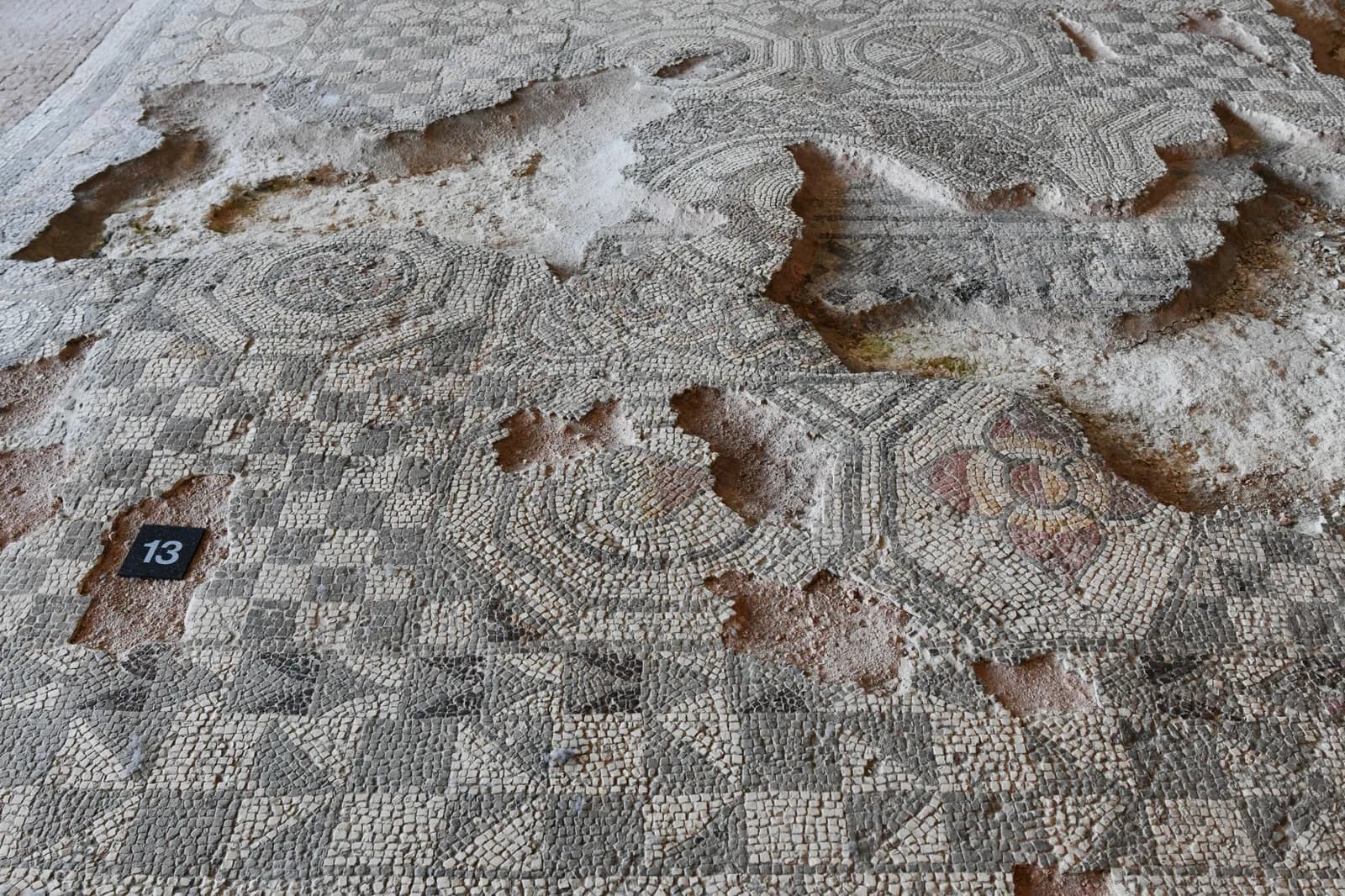
The palace contained as many as 50 mosaic floors, many of which survive in situ. The north wing, which visitors can explore today, includes the Medusa mosaic (laid around 100 AD), the Dolphin mosaic, and the Cupid on Dolphin mosaic (installed around 160 AD during a major redesign). Underfloor central heating, an integral bathhouse, and elaborate formal gardens completed this display of imperial-level luxury in the Sussex countryside.
The King's Puzzle: Who Built Fishbourne?
The identity of the palace's owner remains a matter of scholarly debate. The prevailing theory, advanced by Barry Cunliffe, associates Fishbourne with Tiberius Claudius Cogidubnus (or Togidubnus), a pro-Roman local chieftain installed as king of several territories following the initial conquest.
Tacitus's Agricola, written around 98 AD, references Cogidubnus's loyalty to Rome. More concrete evidence emerged in 1723, when a damaged marble slab was discovered in Chichester. Reconstructed, the inscription reads: "To Neptune and Minerva, for the welfare of the Divine Temple, by the authority of Tiberius Claudius Cogidubnus, great king of the Britons." Cogidubnus was granted the title legatus Augusti around 60 AD, a distinction normally reserved for Roman statesmen and aristocrats. Cunliffe correlates this elevation with the construction of the palace's large masonry extension in 70 AD.
Alternative theories propose Sallustius Lucullus, a Roman governor of Britain in the late 1st century and possibly the son of a British prince. If the palace was designed for Lucullus, it may have seen only brief use before his execution by Emperor Domitian in or shortly after 93 AD. Other candidates include Verica, a British client king preceding the Claudian invasion, or Tiberius Claudius Catuarus, attested by a gold signet ring discovered nearby in 1995.
Fire and Abandonment
The palace's golden age ended around 270 AD, when the north wing was completely destroyed by fire. Archaeological evidence reveals rubble from collapsed roofs, scattered tiles, melted fittings, and burnt doors still standing in their frames. The cause remains unclear; the destruction may have been accidental or connected to the period of instability during Carausius's revolt around 280 AD.
The damage proved too extensive to repair. Rising water levels and flooding may have influenced the decision to abandon the site. Local inhabitants of Chichester subsequently raided the ruins for building stone. During the early Saxon period, the palace foundations served as a burial ground. Four corpses were discovered within the foundations during excavations.
Fishbourne Today
Fishbourne Roman Palace stands 1½ miles west of Chichester, operated by Sussex Past, the trading arm of the Sussex Archaeological Society. A museum constructed over the excavated north wing protects the largest collection of in situ mosaics in the United Kingdom.
Visitors can explore the recreated Roman gardens, the earliest known in Britain, replanted with authentic Roman species including roses, lilies, rosemary, and various fruit trees. The site is accessible via Fishbourne Station, a five to ten minute walk away, with regular bus services from Stagecoach routes 700 and 56.
Admission costs £15.00 for adults, £7.50 for children and students, with family tickets available. Members of the Sussex Archaeological Society enjoy free entry. The 2025 season runs from April through November, with extended hours during peak summer months.
Sussex's Roman Heritage
Fishbourne forms a cornerstone of Sussex's Roman landscape. Chichester—Roman Noviomagus Reginorum—served as the capital of the Civitas Reginorum and the seat of Cogidubnus's client kingdom. The Atrebates tribe, later known as the Regni, enjoyed early and friendly relations with Rome, creating the conditions for such extraordinary displays of wealth and Romanisation.
Together with Bignor Roman Villa and the remains preserved at The Novium museum in Chichester, Fishbourne demonstrates how deeply Roman civilisation took root in Sussex—and how dramatically that world could vanish, leaving its grandest palace to sleep beneath the soil for centuries.